
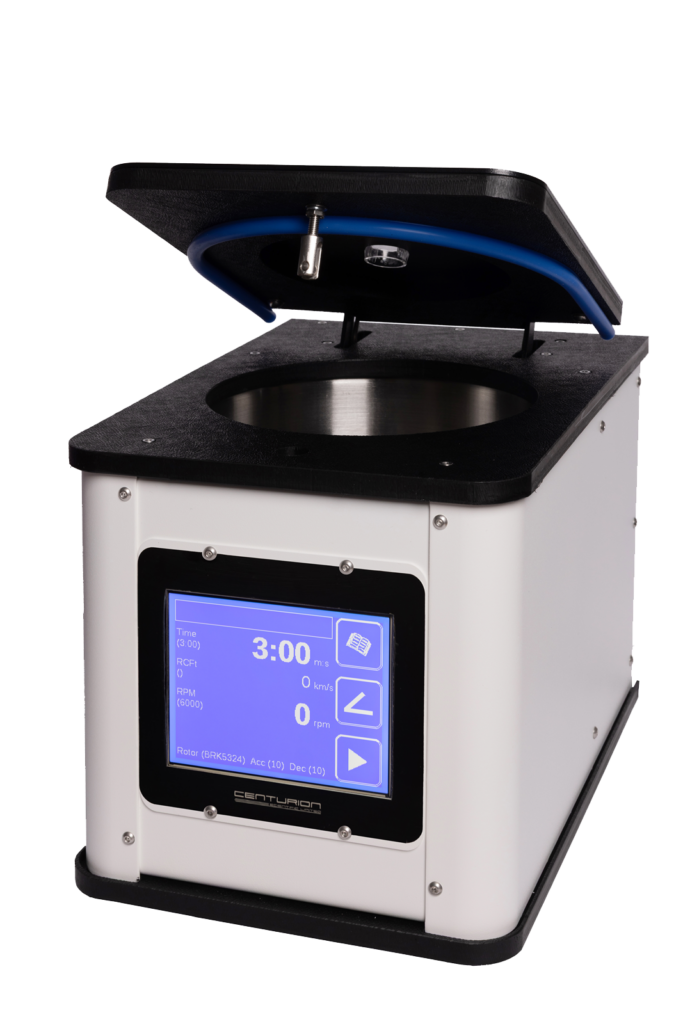
Centrifuges are machines that separate samples into their component parts by spinning them at very fast speeds. This spinning action applies what’s known as a centrifugal force on the sample – forcing the sample’s component parts to separate according to their different densities. Heavier components are forced outwards to the side or bottom of the sample tube, and lighter components are forced to the top.
Centrifuges are a common, essential piece of lab equipment that you’ll find across all scientific, food, clinical, research and heath workplaces. They can be used to separate all kinds of liquids, mixtures and samples into their component, particulate parts.
Centrifugal force is known as a fictitious force. This means it appears as an apparent outward force on an object that is moving in a circle. The reality is that it is in fact centripetal forces* at work inside a centrifuge, but the outcome is the same – when you spin your mixtures at high speeds, the gravitational effect forces the heavier components to separate and be pulled to the bottom and sides of the test tube, leaving the lighter ones at the top.
How effective a centrifuge is at separating component particles is often described as the relative centrifugal force (RCF), also known as g-force.
The key component of all centrifuges are the rotors. These are the racks that the sample tubes sit in and get spun in. There are different types of rotors for different types of sample tube size and desired centrifugal outcomes.
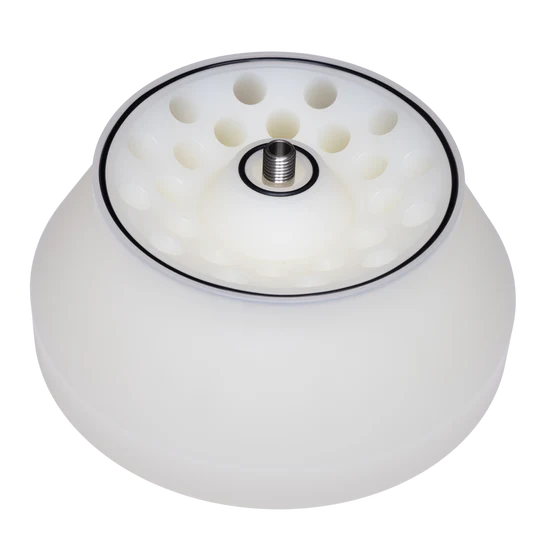
Fixed angle rotors are the most common, and allow for the most secure, fastest processing time. They can achieve the fast rotation and the greatest centrifugal forces in the quickest time.
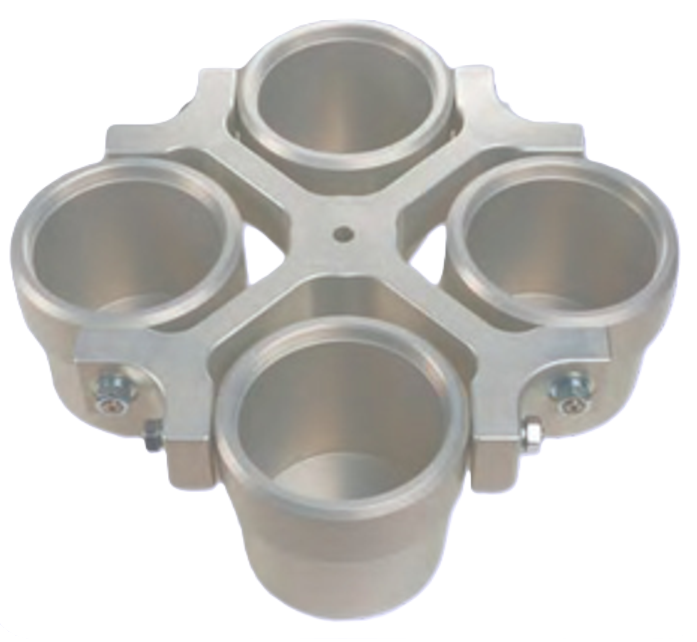
Swing rotors are the other, most common rotor type. These rotors have sample tube holders that are not fixed and swing out during spinning. This gives a more even distribution of the separated components, allowing for increased accuracy and ease of component extraction and reduced smearing.
Total Laboratory Services are proud to be a UK distributor for Centurion Centrifuges – a long established, high quality, British manufacturer of centrifuges and centrifuge rotors. We have a centrifuge for every occasion, and you can view our diverse range of laboratory centrifuges here.
*Centripetal force is the force that keeps an object moving in a circle/rotation and is always pointed toward the centre of that circle/rotation. This force is what gives rise to the fictitious centrifugal force – which is the apparent feeling or appearance of being pushed outward from the centre while in a circular motion.